Piggy’s spectacles
Lord of the FliesPiggy’s spectacles are an indispensable tool whose changing use traces the boys’ dependence on practical knowledge, their effort to organize themselves, and the mounting costs of their conflict. The lenses can concentrate sunlight to kindle a fire, but the same dependence makes Piggy vulnerable: when Jack takes the spectacles, Piggy can barely see, and when one side is broken, he says he has only one eye. The object moves from a personal aid to a contested resource and, finally, a means by which Ralph and Jack briefly cooperate despite their growing division.
Appearance and practical function
Piggy arrives at the mountain in his shirt and shorts, laboring cautiously out of the forest with the evening sunlight gleaming from his glasses and the conch under his arm. The boys have built a large pile of wood but have no matches. When Ralph asks if Piggy has any, Piggy shakes his head. Jack immediately sees another use for the spectacles: the lenses can serve as burning glasses. Before Piggy can back away, the boys surround him, and Jack snatches them from his face. Piggy protests that he can hardly see without them and warns that they might break the conch.
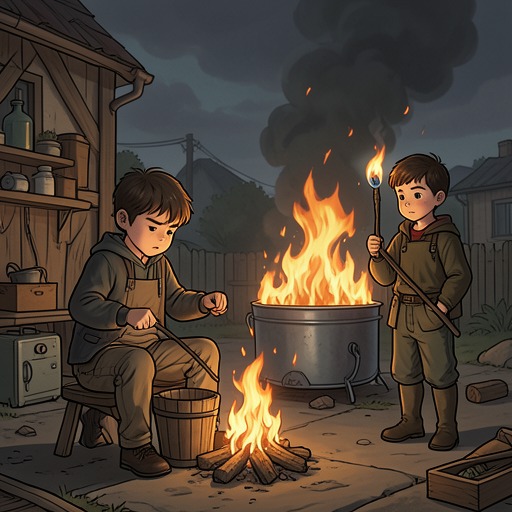
Ralph kneels beside the pile and moves the lenses until an image of the declining sun falls on a piece of rotten wood. Smoke rises; Jack kneels beside Ralph and blows on it until a small flame catches. The fire grows rapidly through the dry wood, and the boys cheer. Piggy, meanwhile, calls for his spectacles. When Ralph returns them, Piggy can only describe his sight as blurs and say that he can hardly see his hand. The scene establishes the double function of the object: its lenses give the group a way to make fire, while removing them immediately restricts Piggy’s ability to see and move with confidence.
From ignition to collective duty
The first blaze consumes the rotten, tinder-dry pile with such force that the boys scatter to feed it, then exhaust themselves as it quickly collapses. Piggy points out that flame alone is not enough: they have not made a fire they can keep going, and the heap will not sustain a signal. The spectacles have solved the immediate problem of ignition, not the larger one of maintaining a visible smoke signal.
That difference matters when the boys discuss rescue. Ralph argues that they need designated people to tend the fire because a ship might appear on the horizon. He also says the conch should authorize speech on the mountain as it does at the meeting place. Jack dismisses Piggy’s claim to speak, even though Piggy holds the conch. He then publicly agrees with Ralph about rules and offers the choir, divided into groups of hunters, to take responsibility for the fire and lookout. The agreement turns a one-time use of Piggy’s lenses into an ongoing duty: the boys must keep a fire ready and add green branches to make smoke if they see a ship.
The spectacles are not what maintains that duty. Later, when the boys see a ship, the fire has gone out because Jack and the hunters have left it to hunt. The contrast exposes the limit of treating the lenses as a complete solution: they can start a fire, but they cannot ensure that anyone tends it. The rescue signal depends on sustained cooperation, and the failure of that cooperation gives the spectacles’ practical success a painful consequence.
Breakage and diminished sight
After the missed ship, Ralph confronts Jack over allowing the fire to go out. Piggy, overcome by the possibility that the boys might have been rescued, joins in the accusation. Jack strikes him in the stomach, then hits his head; the spectacles fly off and strike the rocks. Simon finds them first and gives them back. One side is broken. Piggy puts them on and says that he now has only one eye, making the damage both visible and immediate: an object already essential to his sight has been reduced in usefulness during a dispute in which he had tried to defend the rescue signal.
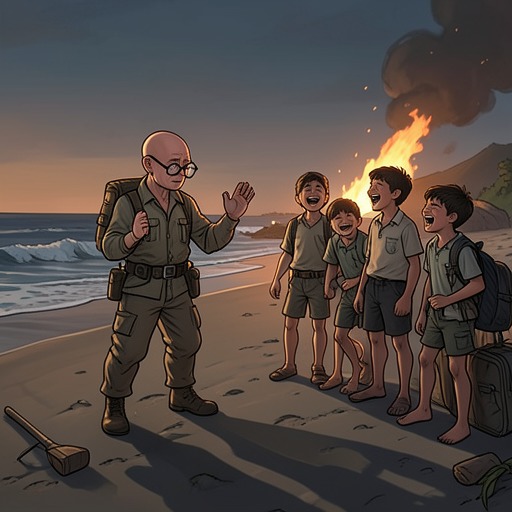
Jack turns Piggy’s difficulty into a joke, imitating his scrambling and repeated warning. The hunters laugh, and the mockery spreads until even Ralph feels his lips twitch, though he is angry with himself for yielding to it. Jack then apologizes for the fire, but Ralph resists the expectation that the apology should settle the matter. The fire is dead and the ship is gone. The breakage therefore belongs to more than a physical scuffle: it occurs amid the loss of a possible rescue and a struggle over whether Jack’s hunting or Ralph’s signal-fire priorities should govern the group.
A resource between rivals
When the boys decide to build another fire, Jack has no way to light it. Ralph goes to Piggy and takes the spectacles; Piggy says he will come too. Ralph focuses the lenses on the wood, and the fire catches at once. Piggy immediately reaches for the spectacles and takes them back. The exchange briefly restores their practical roles: Ralph uses the lenses to accomplish the task, while Piggy remains the person whose sight and possession are at stake.
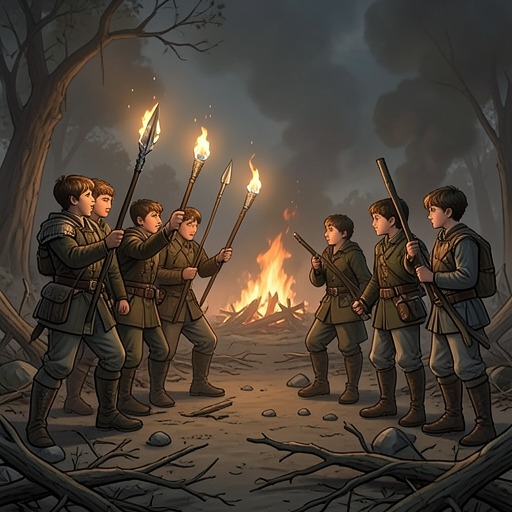
The episode also links the object to the changing relationship between Ralph and Jack. Ralph’s use of Piggy’s spectacles helps produce a moment in which hostility eases around the campfire, even as the boys’ rivalry has already separated them into opposing sides. The lenses do not reconcile their priorities or reverse the damage to Piggy’s sight. They do, however, make cooperation materially possible: the fire can be rekindled only because the group still has access to Piggy’s damaged spectacles. Their repeated movement between Piggy’s face and the fire thus makes a practical dependence impossible to overlook. What enables collective survival remains attached to a boy whom the others can exclude, ridicule, or injure.